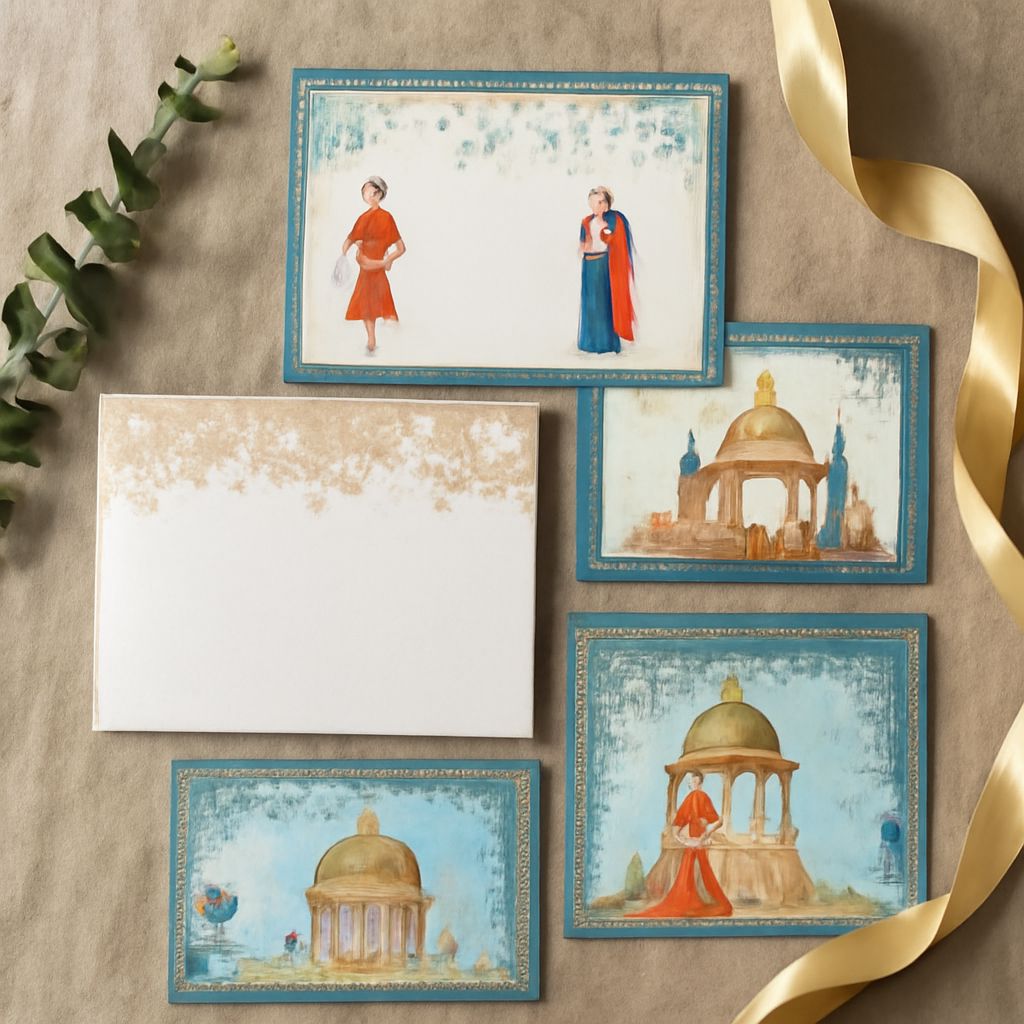
A beautiful invitation should tell your guests who is celebrating, where to go, and which events they are welcome to attend. When you design invitations for an Indian wedding, give each gathering its own clear place on the page. Then choose colors, motifs, and languages that feel at home with your families.
Your celebration may include several events or one gathering, and the names and customs you use will be your own. Begin with the information guests need; the design can give it a lovely frame.
Indian Wedding Invitation Wording: Names and Hosts
Start with the hosts, the invitation, and the couple’s names. If both families are hosting, you can name them together. If you are hosting yourselves, you can speak directly to guests. Agree on spelling, titles, and the order of names with the people involved before sending a proof to the printer.
For example, a family-hosted opening might read:
The Patel and Shah families request the pleasure of your company at the wedding of Anika Patel and Rohan Shah.
A couple-hosted version could say:
Anika Patel and Rohan Shah invite you to celebrate their marriage with them.
These names are examples; use the relationships and names that fit your family. You might include parents’ names beneath each partner’s name, add a blessing meaningful to you, or keep the opening simple. Discuss religious wording and symbols with the relatives or community members who will help you use them appropriately.
An Indian wedding invitation can be formal without becoming a puzzle. Give the couple’s names visual prominence, then leave enough space around the invitation line for it to be read comfortably. A reader should not need a magnifying glass and a second cup of tea to discover who is getting married.
Give each event a separate block
List events in chronological order, using the name your family uses for each one. Depending on your celebration, that might include a mehndi, sangeet, wedding ceremony, or reception. Briefly explain an unfamiliar event on an insert or website if some guests may appreciate context.
For every event, include:
- Event name and invitation: State clearly who is invited to this particular gathering.
- Date and time: Include the day of the week, full date, and start time. Add an end time when it helps guests plan a break or transportation.
- Location: Give the venue name and full street address, including city and state. Add a room name or entrance if needed.
- Practical notes: Include a dress suggestion, accessibility information, or a contact when relevant.
- RSVP: Explain how and by when to reply, and ask guests to respond separately for each event they are invited to.
A sample block might look like this:
Sangeet
Friday, October 16, 2026, at 6:00 p.m.
Garden Hall, 100 Main Street, Princeton, NJ 08540
Dinner and music to follow. Festive attire welcome.
The address and event are illustrative. Repeat the same structure for the ceremony and reception, even if they share a venue; guests can then see the schedule without hunting through a paragraph. If only some people are invited to a smaller event, give those guests a separate insert or a clearly tailored digital invitation.
Select colors and details with meaning
For wedding invitations, Indian families may choose a familiar motif, a favorite color, or a design that reflects both partners’ backgrounds. Ask what a symbol means to the people for whom it is significant before using it as decoration. A floral border, an architectural pattern, or a simple illustration of your venue can also give the suite character.
You might pair deep red with cream and gold for a rich look, or try a softer palette of sage and ivory. Modern Indian wedding invitations can use generous white space, one fine border, and a restrained accent color while still carrying a family motif. Choose a combination you enjoy, then test whether the lettering stands out clearly against the background.
For the type, pair one decorative font for names or headings with a straightforward font for dates and addresses. Avoid putting the entire schedule in ornate script. Print a sample at its actual size and ask someone unfamiliar with the plans to read it: if a time or address takes a second look, make it larger or darker.
Make room for two languages
Bilingual invitations for an Indian wedding can help guests feel included and let each family see familiar words. You might place the two languages on facing sides of a card, on separate inserts, or in clearly labeled sections. Give both versions enough room for names, dates, times, locations, and RSVP instructions; a beautiful translation that omits the venue is rather less helpful.
For Indian wedding cards in two languages, choose a readable font that supports the script and check the final proof on paper as well as on screen. Ask a fluent reader to review the wording, names, and any religious text. Check that the event details match in both languages and that neither version has been reduced to tiny type to make it fit.
Use inserts or a short digital page
In invitations for Indian weddings with several events, an insert is handy when the main card would otherwise be crowded or guests are invited to different combinations of events. Keep each insert labeled with its event and match it to the correct envelope. A brief digital page can hold directions, parking, attire guidance, accessibility details, and individual event RSVPs. Include a short address or QR code and a contact for guests who prefer to reply another way.
Before sending, check the names and wording with both families, proofread each language, and confirm the date, time, address, and RSVP method for every event. Finally, check that each guest receives information only for the gatherings to which they are invited.